
My last post referred, almost in passing, to the Circle of Confusion and quite rightly someone asked for clarification. So apologies for that and here goes… I’ve endeavoured to keep things as easy to understand as possible but if it’s not right up your Straße then don’t panic: Pour yourself a coffee instead and listen to some soothing music eg Windmills of Your Mind😉wink wink.
Understanding the Circle of Confusion
When you take a photo, you want certain parts of the image to be in sharp focus, while other parts might be intentionally blurred. The “Circle of Confusion” (CoC) is a term that helps photographers understand how focus works and how to control it to get the desired effect in their images.
What is the Circle of Confusion?
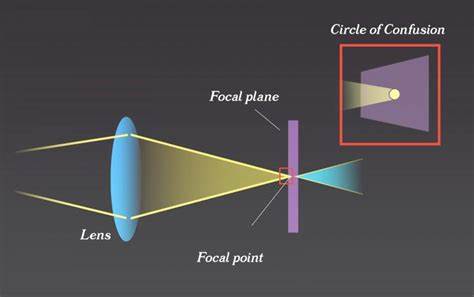
The Circle of Confusion refers to the size of the blur spot created when a point of light from the subject is not perfectly focused on the camera’s sensor (the focal plane in the image above). In simpler terms, it’s the area where light rays converge to form a point. If this point is not perfectly sharp, it appears as a small circle rather than a dot. The size of this circle determines whether the point appears in focus or out of focus in the final image.
Why is it Important?
Understanding the Circle of Confusion is crucial for photographers because it directly affects the depth of field (DoF) in an image. Depth of field is the range of distance within a photo that appears acceptably sharp. By controlling the Circle of Confusion, photographers can manipulate the depth of field to either isolate a subject with a blurred background or keep everything in the scene sharp.
Factors Affecting the Circle of Confusion
Several factors influence the size of the Circle of Confusion:
- Aperture: The aperture is the opening in the lens that lets light into the camera. A larger aperture (smaller f-number) creates a shallower depth of field, resulting in a larger Circle of Confusion for out-of-focus areas. Conversely, a smaller aperture (larger f-number) increases the depth of field, making the Circle of Confusion smaller and more points in the image appear sharp.
- Focal Length: The focal length of the lens also affects the Circle of Confusion. Longer focal lengths (telephoto lenses) tend to have a shallower depth of field, leading to larger Circles of Confusion for out-of-focus areas. Shorter focal lengths (wide-angle lenses) have a deeper depth of field, resulting in smaller Circles of Confusion.
- Distance to Subject: The distance between the camera and the subject plays a role as well. The closer the subject is to the camera, the shallower the depth of field, and the larger the Circle of Confusion for out-of-focus areas. As the distance increases, the depth of field becomes deeper, and the Circle of Confusion becomes smaller.
Practical Applications
Understanding and controlling the Circle of Confusion can help photographers achieve various creative effects:
- Portrait Photography: In portrait photography, a shallow depth of field is often desired to make the subject stand out against a blurred background. By using a large aperture and a longer focal length, photographers can create a larger Circle of Confusion for the background, resulting in a pleasing bokeh effect.
- Landscape Photography: For landscape photography, a deep depth of field is usually preferred to keep everything in the scene sharp, from the foreground to the background. Using a smaller aperture and a shorter focal length helps achieve this by minimizing the Circle of Confusion.
- Macro Photography: In macro photography, where subjects are very close to the camera, achieving a sufficient depth of field can be challenging. Photographers often use techniques like focus stacking, where multiple images with different focus points are combined to create a final image with a greater depth of field and smaller Circles of Confusion.
Calculating the Circle of Confusion
While the concept might sound complex, calculating the Circle of Confusion can be simplified with some basic formulas. The Circle of Confusion is often defined by the camera manufacturer based on the sensor size and the intended viewing conditions. There are on line calculators/cheat sheets for this. This formula provides a general guideline, but the actual acceptable Circle of Confusion can vary depending on the photographer’s preferences and the intended use of the image. Check it all out on line.
Conclusion
The Circle of Confusion is a fundamental concept in photography that helps photographers understand and control focus and depth of field. By mastering this concept, photographers can create images with the desired sharpness and blur, enhancing their creative expression. Whether you’re shooting portraits, landscapes, or macro subjects, understanding the Circle of Confusion will empower you to take your photography to the next level.
Happy snappin’ folks
 Meter The Light